

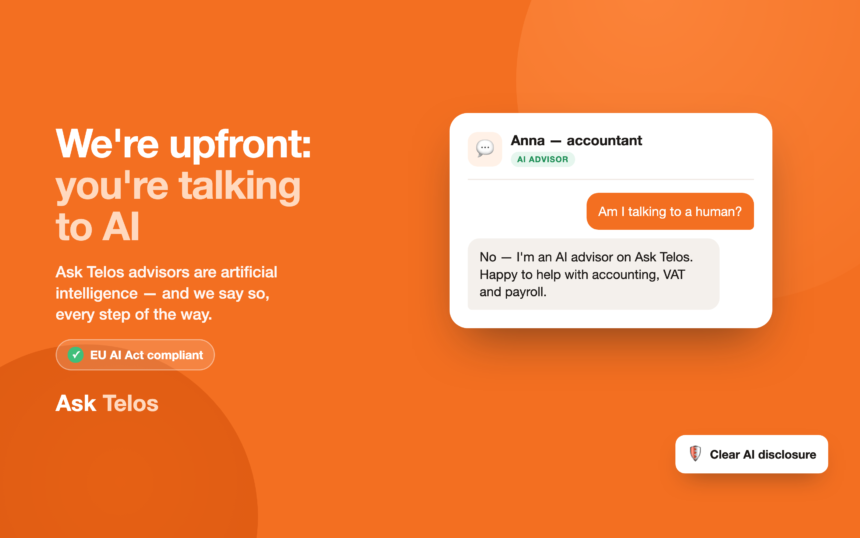
The market for AI assistants is growing at a pace few expected not long ago — and with it returns a fundamental question of trust: am I talking to a human or a machine? Many companies would rather not spell it out, hoping a “human” chat tone will make a better impression. Ask Telos, a Polish chat-consultation platform, took the opposite route and turned it into a signature: its advisors are artificial intelligence, and it says so openly.
“Ask directly, and you’ll hear the truth” — that’s the spirit the whole service is built on. When a user asks an advisor whether it’s a human, the advisor replies that it’s an AI advisor and immediately gets back to helping within its field. The information about the nature of the service isn’t buried in the terms and conditions — it appears on every expert’s profile, before the conversation begins, and in the chat window. This approach aligns with the spirit of the EU AI Act, which requires users to know clearly that they’re dealing with artificial intelligence, no later than the first interaction.
Transparency here goes hand in hand with safety. Advisors give practical, informational answers, but when a matter goes beyond their competence or requires credentials — law, medicine, finance and taxes, gas or electrical installations — they direct the user to a licensed professional, and in emergencies they point to the local emergency number. The system deliberately doesn’t pretend to be a credentialed expert, doesn’t issue “diagnoses” where an on-site inspection is needed, and doesn’t encourage sharing sensitive data.
Why does the company lean so heavily on openness? Because a user who knows what they’re talking to uses the advice more wisely. They treat it as a fast, cheap first step — a starting point that helps them understand the problem, ask the right questions and make a decision — rather than an infallible oracle. That builds real rather than superficial trust, and it protects both sides: the user from over-relying on a machine, and the service from promises it can’t keep.
At a time when artificial intelligence is often presented as a “real consultant,” stating the facts openly is sometimes seen as a marketing risk. Ask Telos assumes the opposite — that honesty will become a competitive advantage as users learn to tell apart the tools that play with an open hand from those that pretend to be something they’re not. Behind the platform stands the Bydgoszcz-based company TELOSAI, which says transparency will remain its principle as it adds new features and enters new markets.