

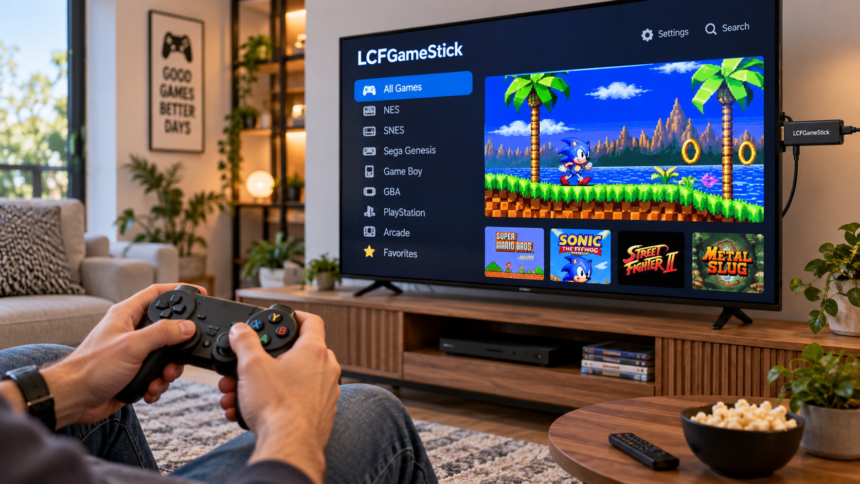
Setting up an LCFGameStick generally involves connecting the gaming stick to your television’s HDMI port, supplying power through its USB connection, selecting the correct TV input, and getting the controllers working. Once the device displays its main menu, you can browse available games, configure supported settings, and begin playing. These instructions for LCFGameStick explain the setup process, controller connections, display adjustments, and practical solutions to common problems.
| Feature | Details |
|---|---|
| Device name | LCFGameStick (LCF Game Stick) |
| Device category | Compact HDMI gaming device |
| Primary purpose | Playing games through a compatible television or display |
| Video connection | HDMI |
| Power connection | USB power connection |
| Controls | Game controllers, with connection methods depending on the model |
| Configuration | On-screen menus and available device settings |
| Setup requirements | Compatible display, power source, and controller |
| Important limitation | Exact features and instructions may vary between device versions |
What Is LCFGameStick and How Does It Work?
LCFGameStick is described in online gaming guides as a compact gaming device that connects to a television or compatible monitor through HDMI. It is intended to provide access to games without requiring a conventional desktop computer or full-size gaming console.
The device works by sending video and audio output to the connected display while accepting input from a game controller. Depending on the hardware and software installed, users may be able to browse games, change display preferences, and adjust controller settings.
The website LCF Game Stick publishes articles about setup instructions, software updates, upgrades, and special settings. However, publicly available information does not establish a single, consistently documented hardware specification for every device sold or described under this name.
The most important consideration is that specific controller combinations, firmware versions, power requirements, and menu options should be confirmed against the device you own.
Instructions for LCFGameStick: Step-by-Step Initial Setup
The following procedure covers the common HDMI game-stick setup process. Check your supplied documentation for model-specific requirements.
Step 1: Check the Device and Accessories
Before connecting anything, inspect the contents of your package.
Depending on the version, you may have:
- The main gaming stick
- One or more game controllers
- A USB power cable
- A wireless USB receiver
- An HDMI extension cable
- A memory card containing system or game data
- Printed setup instructions
Not every package includes all these accessories. Compare the contents with the seller’s product description rather than assuming something is missing.
Inspect the connections and cables for visible damage. If your device includes a removable memory card, confirm that it is installed correctly before powering on the system.
Step 2: Connect LCFGameStick to Your TV
Locate an available HDMI input on your television or monitor.
Carefully insert the gaming stick into that port. If the HDMI connection is difficult to access, use a compatible extension cable if one is supplied.
Make sure the connection is secure without applying excessive pressure.
Next, turn on the television and use the remote control’s Input or Source button to select the HDMI port where the stick is connected.
For example, if the device is connected to HDMI 2, select HDMI 2 from your television’s input menu.
Selecting the correct HDMI source is essential. Otherwise, the television may display a No Signal message even if the gaming stick is receiving power.
Step 3: Connect the Power Supply
Most HDMI gaming sticks require an external USB power connection.
Connect the appropriate USB cable to the device’s power port, then connect the other end to a compatible USB power source.
Some televisions provide USB power outputs, but their available power can vary. If your stick restarts unexpectedly or does not start, check its required electrical rating and use a suitable power adapter.
Never assume that a particular voltage or current rating applies to every LCFGameStick version.
Once power is connected, allow the device to start.
Step 4: Connect the Game Controllers
Controller connection methods vary between gaming sticks.
If your package includes wireless controllers and a USB receiver, insert the receiver into the appropriate port on the device, following its supplied instructions.
Then:
- Install suitable batteries or charge the controller, as applicable.
- Switch on the controller.
- Follow any pairing instructions supplied with your model.
- Wait for the gaming interface to appear.
- Test the directional controls and selection buttons.
Some controllers connect automatically through their receiver, while others require a pairing procedure.
If the controller does not respond, check its power source, receiver connection, and compatibility before changing advanced settings.
Step 5: Access the Main Menu
Once the device has started successfully, you should see its gaming interface.
The layout depends on the installed software, but game-stick interfaces commonly provide access to game collections and configuration options.
Use the controller to move through available menu items.
Start by checking whether you can navigate the interface consistently. Next, select an available game and confirm that it launches.
Avoid changing several settings immediately. Testing the default configuration first helps you identify problems more easily.
How to Configure LCFGameStick Settings
After completing the initial setup, you can review the settings provided by your device.
Not every LCFGameStick version offers the same configuration options, so use the actual on-screen menu as your reference.
Display Resolution and Aspect Ratio
Display configuration affects how games appear on your television.
For example, older games were often designed around a 4:3 aspect ratio, while modern televisions commonly use 16:9 widescreen displays.
If the device offers aspect-ratio controls, you may be able to preserve the original proportions of older games rather than stretching them across the screen.
If the picture looks distorted, blurry, or cut off:
- Check your television’s aspect-ratio settings.
- Review any available display options on the gaming stick.
- Disable excessive TV overscan if your television supports that adjustment.
- Return to the previous display setting if a new configuration makes the picture worse.
Leave resolution settings at their defaults unless you have a specific reason to change them.
Controller Button Mapping
Button mapping determines which controller buttons perform particular actions.
Some gaming interfaces allow users to modify these assignments through their controller configuration menus.
If supported, this can be useful when the default controls feel uncomfortable or a game requires a different layout.
When adjusting button mapping, change one assignment at a time and test the result.
Be particularly careful when changing the buttons used to confirm or cancel menu selections. Incorrect assignments can make navigation difficult.
Audio and Volume Settings
The gaming stick typically sends audio through its HDMI connection.
If a game displays correctly but produces no sound, first check the television’s volume and mute settings.
Next, examine the device’s audio settings if available.
If your television sends sound through a soundbar or external receiver, verify that the television is using the intended audio output.
Do not modify advanced audio options until basic volume and connection checks have been completed.
How to Find, Launch, and Save Games
After completing the setup, open the game’s selection interface.
Depending on the software installed, the gaming library may be presented as a list, collection of categories, or console-based menu.
Choose a title and use the controller’s designated selection button to launch it.
Once the game begins, check that directional input, action buttons, and audio work normally.
Saving Game Progress
Saving progress depends on the individual game and the software running it.
Some games include their original built-in saving systems. Certain emulation environments also support save states, which store a snapshot of the game’s current position.
However, save-state support should not be assumed for every LCFGameStick configuration.
Check the in-game menu or emulator settings for available save options. If a game supports saving, test the feature before relying on it for a lengthy gaming session.
Similarly, the button combination used to leave a game may differ by device. Consult the controller instructions or the displayed menu rather than assuming that a universal shortcut exists.
Can You Add More Games to LCFGameStick?
Some HDMI game sticks support removable storage and additional game files. Whether an LCFGameStick supports this depends on its hardware, operating software, available storage, and emulator configuration.
Before attempting to add games, determine whether your particular device offers a documented import method.
If external game storage is supported, follow the file and folder requirements specified for your model.
Avoid formatting or modifying a memory card until you know whether it contains essential operating-system files. Altering the wrong partition could prevent the device from starting.
Only use game files you are legally entitled to use. Owning an original cartridge or disc does not automatically make every downloaded copy lawful in every jurisdiction.
Common LCFGameStick Problems and How to Fix Them
Even a correctly connected gaming stick can experience display, power, or controller problems.
The following troubleshooting checks help identify common causes without immediately resorting to firmware modifications or factory resets.
| Problem | What to check first |
|---|---|
| TV displays No Signal | HDMI port, selected input, device power |
| Black screen | HDMI connection, startup process, power supply |
| Controller not responding | Batteries, charge, receiver, pairing |
| Game does not launch | Game selection, available files, supported software |
| Distorted picture | Aspect ratio, display resolution, TV scaling |
| No game audio | Volume, mute, HDMI audio settings |
| Device keeps restarting | Power connection and required power rating |
| Settings do not save | Software limitations or potential storage problems |
LCFGameStick Shows a Black Screen
Start by verifying that the television is set to the correct HDMI input.
Then check whether the device is receiving power. If possible, test a different compatible HDMI input.
If an extension cable is being used, inspect its connection and try another suitable cable if available.
A black screen does not necessarily mean that the device is damaged. Problems with video output, power delivery, or startup can produce similar symptoms.
Controller Is Connected but Not Working
Check the batteries or charge level first.
If the controller uses a USB receiver, confirm that it is installed in the correct port.
Power-cycle the controller and follow the pairing procedure specified for your model.
If your device provides a controller configuration menu, check whether the controller is detected before changing button assignments.
Games Freeze or Run Slowly
Game performance depends on the device’s processing capabilities, software, and the requirements of the individual game.
If a game runs poorly, first determine whether the problem affects one title or several.
A problem limited to one game may indicate compatibility or game-file issues. Problems across the entire interface may point to broader software, storage, or power difficulties.
Restart the device normally and retest before making advanced changes.
LCFGameStick Keeps Restarting
Unexpected restarts can be associated with unstable power, damaged connections, or software issues.
Check that the power cable is firmly attached and that the adapter meets the device’s documented requirements.
If the problem continues after basic checks, refer to the product seller or device-specific support documentation before attempting a firmware replacement.
Updating LCFGameStick Software Safely
Software updates may correct errors or introduce changes, but installing an incompatible update can make a gaming device unusable.
The LCF Game Stick website has published an article describing automatic and manual update approaches. However, that article does not establish that every device has identical update functionality.
Before updating:
- Identify your exact hardware model and installed software version.
- Check whether the device provides a built-in update function.
- Verify that any update file comes from a trustworthy, model-compatible source.
- Back up important settings or save data if supported.
- Keep the device connected to reliable power throughout the update.
Do not install firmware simply because another website describes it as compatible with LCFGameStick. Similar-looking gaming sticks can use different internal components.
If there is no verified update available for your particular device, leaving the existing firmware unchanged is generally the safer choice.
Tips for Maintaining Your LCFGameStick
Good operating habits can reduce avoidable problems and help keep the device functioning normally.
Place the gaming stick where it has reasonable ventilation. Avoid covering it with fabric or positioning it next to equipment that produces excessive heat.
Handle HDMI and USB connections carefully, particularly when the device is installed behind a wall-mounted television.
Keep controllers charged or replace their batteries when necessary. Avoid removing storage media while files are being written.
Finally, make a note of settings that work well with your television. If you experiment with display or controller configuration later, having a record of the original settings makes recovery easier.
Frequently Asked Questions About LCFGameStick
1. Does LCFGameStick need an internet connection to work?
Not necessarily. A gaming stick with locally stored games may support offline gameplay. However, software updates, online services, or downloadable content may require internet access if those features are supported. Check your particular device’s capabilities.
2. Can I use LCFGameStick with a computer monitor?
A monitor with a compatible HDMI input may be able to display the gaming stick’s output. The device also needs a suitable power source. If the monitor has no built-in speakers, you may need a compatible way to receive audio.
3. Can I connect a different controller to LCFGameStick?
Possibly, but controller compatibility depends on the hardware and software installed. A controller that works with another gaming system is not automatically compatible with LCFGameStick. Check the supported connection methods before purchasing an alternative controller.
4. Will resetting LCFGameStick delete my games?
It depends on how the device stores its games, settings, and save data. Some reset procedures affect only configuration settings, while others may erase user data or storage contents. Do not perform a factory reset until you understand its consequences and have backed up important data where possible.
Conclusion
Following the correct instructions for LCFGameStick begins with a few essential steps: connect the HDMI output, provide suitable power, select the correct television input, and configure the controller. Once the main interface is working, you can explore the available games and adjust supported display or control settings.
Most basic problems should be investigated through connection, power, and controller checks before attempting software changes. Because LCFGameStick documentation does not clearly establish identical specifications across all versions, the safest approach is to follow the instructions for your exact hardware and avoid unverified firmware or configuration procedures.
With the correct setup and careful troubleshooting, you can make practical use of the gaming features supported by your device.
Read also Decoradhouse Renovation Tips from DecoratorAdvice: A Complete Guide to Smarter Home Improvements