


The answer is closely connected with the way healthcare professionals work. Nurses, physicians, caregivers and other hospital staff may spend a large part of their shift standing, walking between wards and treatment rooms, and moving across smooth floors that are cleaned frequently. Why do so many nurses wear clogs?

For hospitals and clinics, choosing footwear for healthcare staff is therefore not simply a matter of appearance. Weight, slip resistance, stability, ease of cleaning and suitability for professional use all become part of the purchasing decision.
This is one reason why modern medical clogs and lightweight EVA footwear have become an established category in hospitals, clinics, laboratories, care facilities and other professional healthcare environments.
For wholesalers and healthcare footwear distributors, the same factors influence which products are worth adding to a B2B range.
Why are clogs popular with nurses?
Nursing footwear has to respond to a very specific working environment.
A nurse may repeatedly move between patient rooms, corridors, treatment areas and staff facilities during one shift. Footwear is therefore worn for long periods and frequently used on hard, smooth flooring.
Professional clogs address several of these requirements through a relatively simple construction.
Depending on the model, they can provide:
- lightweight construction,
- easy-to-clean surfaces,
- slip-resistant outsole properties,
- heel stability,
- shock absorption,
- moisture resistance,
- antistatic properties,
- quick and uncomplicated use.
These characteristics explain why clogs are frequently considered not only for nurses, but also for physicians, laboratory personnel, caregivers, physiotherapists and professionals working in dental practices and private clinics.
For B2B buyers, however, the important question is not whether a product is simply called a “nursing clog”.
The more useful question is:
Does the footwear have the technical properties required for the workplace in which it will actually be used?
Modern healthcare clogs are different from traditional clogs
Traditional clogs were historically associated with wooden constructions and rigid soles.
Modern professional clogs are a completely different product category.
Materials such as EVA allow manufacturers to produce lightweight occupational footwear that is resistant to moisture and relatively easy to clean. Additional outsole materials can then be used to provide properties required in professional environments.
This distinction is particularly relevant for healthcare procurement teams and distributors.
A modern medical clog should not be evaluated according to the traditional image of a heavy wooden shoe. Buyers should instead examine:
- material,
- outsole construction,
- footwear weight,
- heel stability,
- cleaning requirements,
- occupational footwear certification,
- slip-resistant properties,
- antistatic properties,
- available sizes and colours.
In other words, the purchasing decision should be based on measurable product characteristics rather than the generic term “clog”.For hospitals and clinics, choosing footwear for healthcare staff is therefore not simply a matter of appearance. Weight, slip resistance, stability, ease of cleaning and suitability for professional use all become part of the purchasing decision.
This is one reason why modern medical clogs and lightweight EVA footwear have become an established category in hospitals, clinics, laboratories, care facilities and other professional healthcare environments.
For wholesalers and healthcare footwear distributors, the same factors influence which products are worth adding to a B2B range.
Why are clogs popular with nurses?
Nursing footwear has to respond to a very specific working environment.
A nurse may repeatedly move between patient rooms, corridors, treatment areas and staff facilities during one shift. Footwear is therefore worn for long periods and frequently used on hard, smooth flooring.
Professional clogs address several of these requirements through a relatively simple construction.
Depending on the model, they can provide:
- lightweight construction,
- easy-to-clean surfaces,
- slip-resistant outsole properties,
- heel stability,
- shock absorption,
- moisture resistance,
- antistatic properties,
- quick and uncomplicated use.
These characteristics explain why clogs are frequently considered not only for nurses, but also for physicians, laboratory personnel, caregivers, physiotherapists and professionals working in dental practices and private clinics.
For B2B buyers, however, the important question is not whether a product is simply called a “nursing clog”.
The more useful question is:
Does the footwear have the technical properties required for the workplace in which it will actually be used?
Modern healthcare clogs are different from traditional clogs
Traditional clogs were historically associated with wooden constructions and rigid soles.
Modern professional clogs are a completely different product category.
Materials such as EVA allow manufacturers to produce lightweight occupational footwear that is resistant to moisture and relatively easy to clean. Additional outsole materials can then be used to provide properties required in professional environments.
This distinction is particularly relevant for healthcare procurement teams and distributors.
A modern medical clog should not be evaluated according to the traditional image of a heavy wooden shoe. Buyers should instead examine:
- material,
- outsole construction,
- footwear weight,
- heel stability,
- cleaning requirements,
- occupational footwear certification,
- slip-resistant properties,
- antistatic properties,
- available sizes and colours.
In other words, the purchasing decision should be based on measurable product characteristics rather than the generic term “clog”.

Why does footwear weight matter during long healthcare shifts?
Healthcare professionals frequently work on their feet for many hours.
Although footwear weight is only one selection criterion, it becomes particularly relevant in jobs involving repeated walking throughout the day.
EVA is widely used in modern professional footwear because it makes it possible to create a lightweight and water-resistant shoe body.
For a hospital, clinic or distributor selecting footwear for employees, lightweight construction should be considered together with stability, outsole properties and correct sizing.
The objective is not simply to find the lightest possible footwear.
It is to achieve the right balance between low weight and the professional characteristics required for the job.
Why are EVA clogs suitable for healthcare environments?
EVA has several characteristics that make it useful in professional footwear.
It is lightweight, water-resistant and easy to maintain. Its closed structure also makes it particularly practical in environments where footwear may need regular cleaning.
This creates potential applications across:
- hospitals,
- private clinics,
- dental practices,
- laboratories,
- physiotherapy centres,
- nursing homes and care facilities,
- podiatry practices,
- aesthetic medicine clinics,
- beauty and wellness businesses.
For healthcare footwear distributors, this versatility has another advantage: one professional clog model may potentially serve several related market segments.
That can simplify the product range and reduce the need to maintain numerous highly specialised models for relatively similar workplace requirements.
Why is slip resistance important in nursing clogs?
Hospital and clinic floors are often smooth and cleaned regularly.
For this reason, outsole performance should be an important part of the footwear specification.
A distributor or procurement department should not assume that every clog automatically provides the same level of traction. Slip-resistant properties should be verified in the technical specification of the individual model.
This is particularly important when comparing everyday leisure clogs with occupational footwear specifically developed for professional environments.
The same principle applies to other properties such as antistatic performance, heel energy absorption or resistance to workplace conditions.
The visual similarity between two products does not mean their technical specifications are equivalent.
Why does a heel strap matter in professional clogs?
Professional healthcare workers frequently change direction, move quickly between work areas and spend significant periods walking rather than sitting.
For this reason, heel stability can be relevant.
A heel strap helps keep the shoe in position during movement and differentiates professional clogs from many open-back leisure models.
For B2B buyers, this is a useful example of how a small construction detail can have a practical workplace function.
Instead of describing a product only as a “clog with heel strap”, the feature can be communicated as part of the footwear’s stability during everyday professional use.
Medical clogs or regular leisure clogs – what is the difference?
Not every lightweight clog is professional occupational footwear.
Leisure models may work perfectly well for gardening, home use or recreational activities, but hospitals, clinics and other professional facilities may require clearly defined performance characteristics.
When selecting footwear for healthcare personnel, B2B buyers should verify:
| Selection criterion | Why it matters in healthcare |
| Occupational footwear standard | Confirms the professional specification of the model |
| Slip-resistant properties | Relevant on smooth and regularly cleaned floors |
| Antistatic properties | May be required in specific professional environments |
| Footwear weight | Important during prolonged standing and walking |
| Heel stability | Helps keep footwear positioned during movement |
| Easy cleaning | Supports everyday footwear maintenance |
| Moisture resistance | Useful in frequently cleaned working environments |
| Size range | Important when purchasing footwear for larger teams |
| Consistent availability | Essential for repeat procurement and stock replenishment |
This distinction is particularly important for wholesalers.
A professional footwear range should make it easy for customers to understand why one model is intended for occupational use while another is primarily a leisure product.
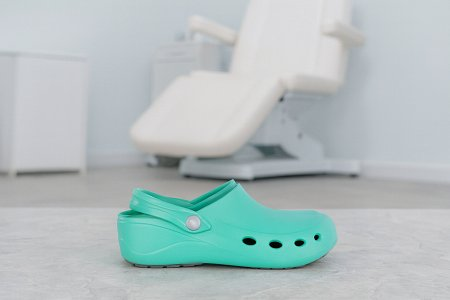
What footwear should hospitals and clinics look for?
Healthcare facilities should begin with the working environment rather than a particular shoe style.
The footwear requirements of a nurse working on a hospital ward may differ from those of a laboratory technician, physiotherapist or employee of a long-term care facility.
Nevertheless, several purchasing criteria repeatedly appear across healthcare environments:
Low footwear weight.
Relevant for employees who spend many hours standing and walking.
Easy cleaning.
Professional footwear should have a construction appropriate for regular maintenance.
Slip resistance.
Particularly important on smooth surfaces and floors that undergo frequent cleaning.
Stability.
Footwear should remain properly positioned during normal workplace movement.
Clear technical documentation.
Procurement teams need to understand exactly which properties are declared for a particular model.
Consistent sizing and availability.
Hospitals, clinics and distributors need to be able to order missing sizes and replenish the range over time.
A broader discussion of medical footwear for hospitals and clinics is available from Camminare Boots, including guidance for healthcare facilities, distributors and procurement teams.
Nursing clogs from the perspective of a B2B buyer
A nurse may evaluate footwear primarily from the perspective of everyday use.
A professional buyer has to look at a larger picture.
Hospitals, medical groups, wholesalers and distributors may need footwear for dozens, hundreds or even more users. That means product consistency and procurement logistics become almost as important as individual product characteristics.
Before choosing a healthcare footwear supplier, B2B buyers should consider:
- full size range,
- availability of core colours,
- technical specifications,
- certification documentation,
- product consistency between production batches,
- ability to replenish popular sizes,
- wholesale ordering conditions,
- packaging and logistics,
- long-term availability of the model.
A clog can perform well as an individual product and still be difficult to manage within a large healthcare procurement programme if sizes, specifications or repeat availability are inconsistent.
What colours work best in professional healthcare footwear?
Colour is not only an aesthetic question.
White remains strongly associated with medical and clinical environments, while black and navy are often used with darker uniforms or in private healthcare and wellness settings.
Additional colours can help differentiate departments, professional groups or brand environments.
For distributors, a balanced colour range is often more practical than an extremely broad assortment.
Core colours can support high-volume institutional orders, while selected additional shades can make the same footwear model attractive to private clinics, dental practices, aesthetic medicine centres and beauty professionals.
This allows one product line to serve both traditional healthcare and adjacent professional sectors.
Prima Clog as an example of professional EVA footwear
Camminare Boots develops professional EVA footwear for B2B customers, including distributors, wholesalers, retailers and organisations purchasing footwear for employees.
Prima Clog is one example of professional occupational footwear in the manufacturer’s range.
The model combines an EVA upper with a TPU outsole and heel strap. It is listed by Camminare Boots with EN ISO 20347:2012 OB SRC A E marking and provides antistatic and slip-resistant properties. It can also be machine washed at temperatures up to 40°C.
These characteristics make it relevant to several professional sectors, including healthcare, beauty, hospitality, catering and other workplaces in which lightweight and easy-to-maintain footwear is required.
Buyers looking to develop a wider professional footwear assortment can compare the available professional EVA clogs for healthcare and workplace use within the Camminare Boots range.
Why is EN ISO 20347 relevant to professional clogs?
Professional buyers should distinguish occupational footwear from safety footwear.
EN ISO 20347 applies to occupational footwear used in workplaces where a protective safety toe cap is not required.
This makes the standard relevant to many healthcare, service and professional environments.
However, buyers should always verify the full marking and declared properties of the particular footwear model rather than treating the standard number alone as a complete description of the product.
For procurement departments, this is particularly important when preparing internal footwear specifications or comparing offers from different suppliers.
How should distributors build a medical clog range?
A medical footwear range does not necessarily need dozens of similar clog models.
A more efficient strategy can be to select products that cover several professional applications while remaining easy to explain to customers.
For example, a professional clog range may be structured around:
- healthcare and nursing,
- dental and laboratory environments,
- elderly care,
- physiotherapy,
- beauty and aesthetic medicine,
- wellness and spa,
- hospitality and catering.
The important factor is that the product specifications match the requirements being communicated.
For distributors, broad application potential can simplify inventory planning, while clear technical documentation makes it easier to position the product correctly for different professional groups.
What should wholesalers ask a medical clog manufacturer?
Before adding a new professional clog to a wholesale range, buyers should ask several practical questions.
What standard does the footwear meet?
The complete certification or occupational footwear marking should be available.
Which properties have been tested or declared?
Slip resistance, antistatic properties, cleaning instructions and construction details should be clearly documented.
Which sizes are available?
A professional range needs sufficient size coverage for institutional and wholesale buyers.
Are core colours continuously available?
Hospitals and distributors often need to replenish established colour variants rather than repeatedly change collections.
Can repeat orders be fulfilled?
Reliable replenishment is particularly important when supplying healthcare facilities or chains.
Can the supplier support B2B and wholesale purchasing?
A manufacturer serving professional markets should understand the requirements of distributors, healthcare procurement teams and organisations ordering footwear for employees.
These questions help buyers evaluate the supplier as well as the product itself.
Medical clog manufacturer for wholesale and professional markets
For a B2B buyer, selecting professional clogs is ultimately about more than choosing a comfortable-looking shoe.
The footwear needs to combine suitable workplace properties with predictable supply, technical transparency and a product range that can be sold or distributed consistently.
Camminare Boots is a Polish EVA footwear manufacturer supplying professional footwear to B2B customers. Its clog range is designed for applications including healthcare, beauty, hospitality and other service sectors.
For hospitals and clinics, the key purchasing question should therefore be:
Which footwear specification best matches the actual workplace?
For distributors and wholesalers, a second question is equally important:
Can the manufacturer supply that product consistently as the business grows?
When both questions can be answered clearly, professional clogs become not merely another footwear category, but a manageable and scalable part of a healthcare or occupational footwear portfolio.