

Reviewed: September 12, 2026
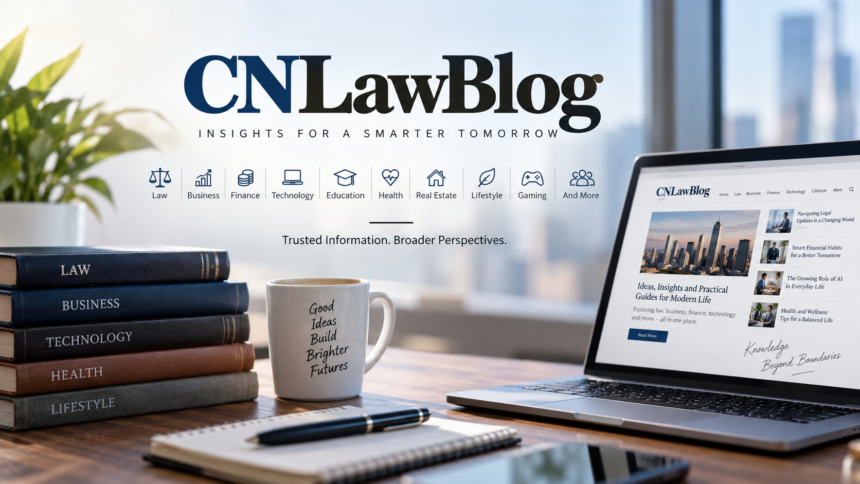
CNLawBlog is best understood as CNLawBlog.com, an independent online publication covering far more than law. Its current website publishes material on law, business, finance, technology, education, health, real estate, lifestyle, gaming, consumer topics, and other subjects. The publication says it was founded in August 2018. Archived pages on the same domain show articles dated August 13 and August 16, 2018, supporting the existence of content on the site from that period.
Two distinctions matter immediately. CNLawBlog.com is not presented as a government legal database, court, regulator, or law firm, and it should not be confused with the much older China Law Blog published by the international law firm Harris Sliwoski. Those are separate publications with different domains, histories, publishers, and editorial focuses.
CNLawBlog at a Glance
| Question | Answer |
|---|---|
| What is CNLawBlog? | An independent multi-topic digital publication |
| Official website | CNLawBlog.com |
| Stated founding date | August 2018 |
| Main subjects | Law, business, finance, technology, education, health, real estate, lifestyle, gaming and consumer information |
| Is it a law firm? | The site does not present itself as one |
| Is it an official legal authority? | No; its own material describes it as an independent informational platform |
| Does it accept outside contributions? | Yes, it publicly advertises guest-post submissions |
| Is it the same as China Law Blog? | No |
| Appropriate use | Background reading and general information, with important claims checked against primary sources |
The site’s own About page provides the clearest description of its present identity. Read the official CNLawBlog About page
What Does CNLawBlog Actually Publish?
The name can give the impression that the site is devoted specifically to law, or perhaps to Chinese law. Its present content does not support that interpretation.
CNLawBlog’s homepage currently identifies sections and articles spanning numerous subjects. Recent and indexed examples include personal finance and online-loan scams, medical financing, artificial intelligence and data sovereignty, gaming guides, screen-time and lifestyle articles, as well as legal and law-related material.
The site’s own About page similarly lists law alongside technology, business, finance, education, health, home improvement, real estate, lifestyle, gaming, consumer information and general practical guides.
That broad editorial range is not entirely new. Articles currently indexed on the domain include an August 2018 GMAT article, an August 2018 piece about Urdu calligraphy, later finance content, technology articles and entertainment-related material. This history makes it more accurate to describe CNLawBlog as a general-interest publication that includes legal content rather than a specialist legal research service.
Does “CN” in CNLawBlog Mean China?
Readers should be cautious about assuming that it does.
Some third-party pages interpret “CN” as meaning China, but CNLawBlog’s current About page does not provide that expansion or define the initials that way. Searches of the publication’s indexed pages also do not establish an official statement that the name means “China Law Blog.”
More importantly, the site’s actual subject matter is international and multi-category rather than being confined to Chinese law.
The safest conclusion is therefore straightforward: the name alone should not be used as evidence that CNLawBlog is a Chinese-law publication.
Is CNLawBlog the Same as China Law Blog?
No. This is the most important distinction for anyone researching the keyword.
China Law Blog is a separate publication currently hosted by international law firm Harris Sliwoski. Its archive contains an introductory post dated January 4, 2006, explaining that the blog would focus on the practical effects of Chinese law on businesses operating in or dealing with China. The publication was still actively posting in September 2026.
Harris Sliwoski identifies international lawyer Dan Harris as the principal writer of China Law Blog. His firm biography describes his work in cross-border transactions, manufacturing, trade, intellectual property and disputes, particularly involving China and other international markets.
Visit the Harris Sliwoski China Law Blog
CNLawBlog.com vs. China Law Blog
| Feature | CNLawBlog.com | China Law Blog |
|---|---|---|
| Domain | cnlawblog.com | harris-sliwoski.com/chinalawblog |
| Publication type | Independent multi-topic publication | Law-firm publication |
| Earliest confirmed material reviewed | August 2018 | January 4, 2006 |
| Primary focus | Multiple general-information categories | Practical Chinese and international business law |
| Publisher named on the site | CNLawBlog describes itself as an independent publication | Harris Sliwoski LLP |
| Legal specialization | One part of a much broader content mix | Central to the publication |
| Same publication? | No | No |
This distinction also explains why search results for “cnlawblog,” “CN Law Blog” and “China Law Blog” can produce apparently contradictory descriptions. Searchers may be encountering two unrelated entities with very similar names.
Who Writes CNLawBlog?
Pages currently indexed from CNLawBlog display several bylines, including Jamie, mansi, and, on older material, Roland. The publication’s About and Editorial Policy pages focus primarily on site-wide publishing standards rather than presenting the publication as the work of a single named lawyer or legal institution.
That matters particularly for legal, medical and financial material. A useful article does not automatically become an authoritative professional source simply because it is clear or appears prominently in search results. Readers should check the expertise behind the particular article they are using, especially when its conclusions could affect contracts, lawsuits, regulatory obligations, health decisions or substantial financial transactions.
How Does CNLawBlog Describe Its Editorial Process?
CNLawBlog has published an Editorial Policy outlining how it says content is researched, reviewed, corrected and updated.
The policy says the publication aims to produce accurate and understandable educational material, may update articles when regulations or other facts change, and invites readers to report inaccuracies. It also says sponsored or partnership content is identified when applicable.
The policy contains another useful disclosure: digital tools may assist parts of the editorial workflow, including research organization, drafting assistance, language refinement, grammar checking and content optimization. CNLawBlog says articles nevertheless receive human review before publication.
Read CNLawBlog’s Editorial Policy
These statements provide useful transparency, but an editorial policy is still a publisher’s description of its own procedures. Readers evaluating a specific article should also look at whether that article actually cites statutes, regulators, court decisions, research papers or other appropriate primary evidence.
CNLawBlog’s Guest-Post and Backlink Policy
CNLawBlog also operates a public guest-post program.
Its submission page says outside writers may contribute articles across legal, business, finance, technology, gaming, education, career and general-information topics. It requires original material, says submissions are manually reviewed, and allows contributors to include one or two “dofollow” backlinks when those links are considered relevant. The site’s FAQ says whether guest posting is free depends on the submission and that prospective contributors should contact the publication for details.
That combination deserves careful handling from an SEO perspective.
Google’s official documentation says ordinary editorial links do not need a special rel attribute. However, links created because of advertising, sponsorship or another compensated arrangement should generally be marked rel="sponsored"; nofollow remains an acceptable alternative for paid links. Google’s spam policies also identify buying or selling links for ranking purposes as link spam when those links are not appropriately qualified.
Google Search Central: Qualify outbound links
This does not establish that CNLawBlog is violating Google’s rules. A guest post may be genuinely editorial, unpaid and independently accepted, and the public policy does not tell us the commercial circumstances or HTML attributes used for every individual published link.
It does mean that site owners and contributors should distinguish between editorial links and compensated placements. If payment, sponsorship, free products, services or another commercial arrangement is involved, the link treatment should follow Google’s guidance rather than relying on “dofollow” as an advertised SEO benefit.
Is CNLawBlog a Reliable Source?
There is no useful yes-or-no answer that applies to every article on a site covering this many unrelated subjects.
CNLawBlog can serve as a secondary starting point when an article explains a topic clearly and identifies enough evidence for the reader to verify its claims. It should not automatically be treated as final authority on a legal question merely because “law” appears in the domain name.
A stronger assessment depends on the particular page:
| What to check | Why it matters |
|---|---|
| Named author or reviewer | Shows who is responsible for the material |
| Relevant professional expertise | Especially important for law, medicine and finance |
| Publication and update dates | Rules and regulations can change |
| Jurisdiction | Legal rules differ by country, state and sometimes municipality |
| Links to statutes, regulators or court records | Allows independent verification |
| Clear distinction between fact and opinion | Reduces the risk of treating interpretation as law |
| Commercial relationships | Helps identify advertising or sponsored recommendations |
| Corrections and updates | Important for subjects that change over time |
For ordinary background reading, those checks may be enough. For an actual legal problem, contract, regulatory deadline, court proceeding or rights dispute, readers should go to the relevant legislation, court, regulator or qualified lawyer rather than relying on any general-purpose blog as their final source.
Why Primary Sources Matter for Legal Information
Legal articles are most useful when they help readers reach the underlying authority.
A blog can explain what a statute means in practice, summarize a regulatory change or translate complicated terminology into plain English. It cannot replace the controlling law itself.
This becomes especially important when an article lacks a jurisdiction, relies on unsourced numerical claims, discusses changing regulations without a date, or presents a general rule without explaining exceptions.
The same principle applies whether the page appears on CNLawBlog or another publisher: the strength of a legal claim comes from the authority supporting it, not from the domain name or search ranking of the page making it.
The Site’s Identity Has Evolved
One reason descriptions of CNLawBlog differ across the web is that the site itself contains material reflecting different ways of positioning the publication.
A March 2026 page describes CNLawBlog primarily as a platform simplifying corporate, civil and criminal law, legal updates and case studies. Its broader current About page, however, describes an independent publication covering many non-legal categories as well. The homepage confirms the broader model through its mix of law, finance, technology, gaming and lifestyle material.
Historical pages add further context: non-legal articles were already appearing on the domain in 2018. The evidence therefore favors describing CNLawBlog by what it demonstrably publishes across time rather than using the narrower description found on one self-referential page.
Bottom Line
CNLawBlog.com is a real, active, independent digital publication, but it is not simply a Chinese-law blog or an official legal research service. Its present coverage spans law, finance, technology, business, education, health, lifestyle, gaming and numerous other subjects. The publication says it was founded in August 2018, and dated articles on the domain support activity from that month.
It should also be kept separate from China Law Blog, the Harris Sliwoski publication whose archive dates to January 2006 and whose core subject is the practical legal environment for businesses dealing with China.
CNLawBlog can be useful for discovering or understanding a topic, but legal, medical, financial and other high-impact claims should be checked against primary authorities. Its guest-post program also means readers should evaluate individual articles on their own evidence and authorship rather than assuming every page has the same level of expertise.
For publishers using external links, the Google-compliant approach is similarly simple: link naturally to authoritative sources when they help the reader, and properly qualify sponsored or compensated links instead of using them to pass ranking credit.
Read also Tozymagazine.com: What Tozy Magazine Is, What It Publishes, and What Readers Should Know