

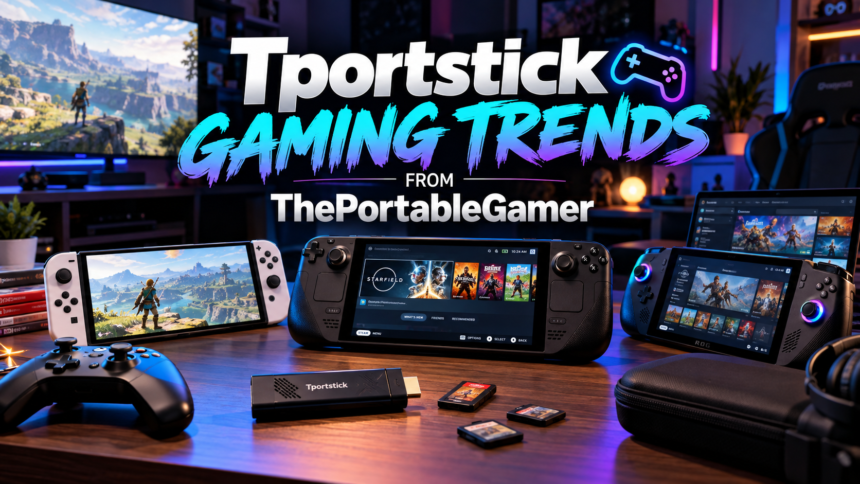
Gaming has changed a lot in recent years. There was a time when playing high-quality games meant sitting in front of a television or spending hours at a computer desk. Now, powerful handheld consoles, mobile devices, and cloud gaming services make it possible to enjoy games almost anywhere.
The growing interest in tportstick gaming trends from ThePortableGamer reflects these changes. Gamers are paying more attention to portable devices, flexible gaming setups, online multiplayer features, and technologies that make gaming easier to access.
But not every trend deserves the same attention. Some developments are already changing how people play, while others remain promising ideas that need more time to mature.
This article explores the real developments behind these gaming trends, explains how they affect everyday players, and examines what the future could hold for portable entertainment.
What Are Tportstick Gaming Trends From ThePortableGamer?
The phrase tportstick gaming trends from ThePortableGamer is associated with online coverage of portable gaming technology, handheld devices, cloud streaming, and changing player habits.
ThePortableGamer published an article on September 30, 2026, highlighting three major areas: cloud gaming, compact handheld hardware, and cross-platform social features. Its coverage also discusses gaming accessories, community activity, and the growing demand for flexible gaming experiences.
One point deserves clarification. Tportstick has not been independently verified as a recognized mainstream gaming console or established hardware standard. Different websites use the term in different ways, sometimes discussing a gaming device and sometimes describing broader industry trends.
Rather than assuming it refers to one specific product, it makes more sense to examine the genuine gaming technologies connected with the phrase.
These developments are already influencing gaming companies, hardware manufacturers, content creators, and millions of players worldwide.
Why Portable Gaming Is Growing
Portable gaming has become popular because it fits naturally into modern lifestyles.
Not everyone has the time or space for a traditional gaming setup. Some people prefer playing during their commute, while others enjoy short gaming sessions after work or while traveling.
Handheld devices offer a practical alternative. They combine entertainment and convenience without always requiring a separate television or monitor.
There is also a growing variety of games available across smartphones, portable consoles, and handheld PCs. Players can choose everything from simple puzzle games to demanding role-playing adventures.
According to Newzoo’s 2026 Global Games Market Report, worldwide video game revenue is forecast to reach $213.9 billion in 2026. Mobile gaming alone is projected to generate approximately $121.1 billion.
These figures cover the wider gaming market rather than handheld consoles specifically, but they show the substantial economic role of gaming across portable and traditional platforms.
For gamers, the biggest benefit is choice. Playing games no longer requires committing to one location or a single type of device.
Handheld Consoles Are Getting Better
One of the most noticeable gaming trends is the continued development of powerful handheld consoles.
Older portable systems often required major compromises in graphics and performance. Modern devices can run much more demanding games while offering better displays and more comfortable controls.
The Nintendo Switch 2 provides a strong example.
According to Nintendo’s official specifications, the console features a 7.9-inch LCD display with 1080p resolution, HDR support, and variable refresh rate technology. It supports refresh rates of up to 120Hz in compatible handheld games.
Players can also connect the device to a television, with support for resolutions up to 4K in compatible games.
This combination of handheld and home-console functionality gives players greater freedom.
Someone can play a game on the sofa, continue it during a journey, and later connect the same console to a larger screen.
The appeal goes beyond technical improvements. Hybrid systems make gaming more convenient for families, travelers, and players who do not want multiple devices.
Handheld Gaming PCs Are Expanding
Handheld PCs have become an important part of portable gaming.
Unlike traditional consoles, these devices allow players to access many of the games available through established PC gaming platforms.
The Steam Deck OLED is one well-known example. It features a 7.4-inch HDR OLED display, a refresh rate of up to 90Hz, and controls designed for games that normally use a keyboard, mouse, or traditional controller.
Valve’s official specifications also list a battery-life range of approximately three to twelve hours, depending on the game and usage conditions.
Other devices, including the ROG Xbox Ally and ROG Xbox Ally X, bring Windows-based gaming into handheld form.
These systems appeal to people who already own PC games and want to play them away from their desks.
There are still drawbacks, though.
Certain PC titles are difficult to control on smaller screens. Others may require adjustments to graphics settings, operating-system compatibility, or control layouts.
That is why game compatibility and ease of use are just as important as processing power when choosing a handheld PC.
Cloud Gaming Is Changing Access
Cloud gaming is one of the most interesting developments connected with tportstick gaming trends from ThePortableGamer.
The basic idea is straightforward. Instead of running a game entirely on your device, a remote server handles the demanding processing and streams the gameplay to your screen.
This allows supported smartphones, tablets, laptops, and handheld devices to access games without needing the same level of local hardware performance.
NVIDIA GeForce NOW is an established example of this technology.
According to NVIDIA’s official system requirements, a connection of at least 25 Mbps is recommended for streaming at 1080p and 60 frames per second.
PlayStation has also expanded cloud gaming support for the PlayStation Portal. Eligible PS5 games can be streamed through PlayStation Plus Premium in supported countries.
For players, the attraction is clear. A smaller device can provide access to experiences normally associated with more powerful hardware.
However, cloud gaming is not perfect.
Network latency, unstable Wi-Fi, data usage, regional availability, and subscription requirements can all affect the experience.
Competitive games are especially sensitive to delays between pressing a button and seeing the result on screen.
Cloud gaming is becoming more practical, but locally installed games remain valuable, particularly when internet access is unreliable.
Cross-Platform Gaming Connects Players
Gaming has always been more enjoyable when friends can play together.
Unfortunately, different consoles and gaming platforms have historically made that difficult.
Cross-platform technology is helping reduce those barriers.
With cross-play, players using different supported systems can participate in the same multiplayer games.
Titles such as Fortnite and Rocket League are examples of games that support cross-platform multiplayer.
Another important feature is cross-progression, which allows players to access supported saved progress across different devices.
Imagine spending an evening progressing through a game on your computer and later continuing on a compatible handheld device. When cross-progression works correctly, there is no need to restart everything.
Still, these features should not be confused.
Cross-play allows people on different platforms to play together, while cross-progression concerns saved progress and account data. A game can support one without supporting the other.
Some platforms also place restrictions on transferable purchases, in-game currency, and account linking.
For anyone planning to switch between devices, checking these features before buying a game can prevent disappointment.
Mobile Gaming Is Still Growing
Smartphones have become powerful gaming devices in their own right.
Most people already carry a phone, making mobile gaming one of the easiest forms of entertainment to access.
The selection of mobile games is enormous. Players can enjoy racing, strategy, puzzle, sports, role-playing, and multiplayer games without purchasing a dedicated console.
The Entertainment Software Association’s 2026 research reports that mobile devices are used for gaming by 80% of surveyed American video game players.
That helps explain why developers continue investing in smartphone games and mobile-friendly experiences.
Hardware improvements are also making a difference.
Modern smartphones offer increasingly capable graphics processors, high-refresh-rate displays, and accessories that provide more comfortable physical controls.
For many casual players, a smartphone is more than enough.
However, there are disadvantages. Intensive games can produce heat, consume battery power quickly, and require significant storage space.
In-app purchases and aggressive advertising can also affect the overall experience.
Mobile gaming will likely remain important because it combines convenience with a huge variety of games and devices.
Gaming Accessories Matter More
A portable gaming device is only one part of the experience.
Accessories can make gaming more comfortable, especially during longer sessions.
For example, attaching a physical controller to a smartphone can provide better control in racing or action games. A protective carrying case can make traveling with a handheld console easier.
Portable docks are another useful development. Compatible handhelds can connect to monitors, televisions, keyboards, and other accessories.
This makes some devices suitable for both handheld and desk-based use.
ThePortableGamer’s coverage also draws attention to compact hardware and modular accessories.
It is worth remembering that adding external accessories is different from upgrading the internal components of a device.
Many handheld consoles do not allow users to replace major parts such as processors or graphics chips.
Compatibility should always come before appearance or marketing claims when buying gaming accessories.
A controller, dock, or charger is only worthwhile if it works reliably with the device being used.
Retro Games Are Making a Comeback
Not every player wants the newest graphics or the most demanding games.
Many people still enjoy the simple mechanics and familiar visual styles of older titles.
This has created ongoing interest in retro handheld consoles and compact gaming devices.
Retro gaming appeals to longtime players who want to revisit childhood favorites, but it also introduces younger audiences to games they may never have experienced.
Some dedicated handhelds are designed specifically for classic game collections, while others support a wider range of older gaming systems through appropriate software.
Compact plug-and-play gaming sticks have also attracted attention because they can connect to a display and offer a convenient way to play.
However, product quality varies considerably.
Some inexpensive devices are advertised with thousands of preinstalled games, even when licensing information is unclear.
Buyers should check whether the included games are officially licensed, whether the controllers are reliable, and whether the manufacturer provides software support.
Retro gaming can be affordable and enjoyable, but choosing legitimate, well-supported products makes a difference.
Battery Life Remains a Challenge
There is one problem that nearly every portable gamer understands: a low battery at the wrong moment.
Gaming devices have become more capable, but demanding games still consume substantial amounts of power.
High screen brightness, advanced graphics, wireless connectivity, and faster processors can all reduce battery life.
Nintendo, for example, estimates that the Switch 2 provides approximately two to six and a half hours of battery life, depending on the software and usage conditions.
The difference between light and demanding games can be significant.
For everyday players, battery performance is often more important than small improvements in graphics quality.
Reducing brightness, limiting frame rates, and choosing appropriate performance settings can sometimes extend a gaming session.
A stable frame rate may also feel better than constantly switching between higher and lower performance levels.
Manufacturers face a difficult challenge here. Increasing battery capacity can add weight, while more powerful hardware generates additional heat.
Future handheld improvements will depend partly on finding a better balance between speed, temperature, battery size, and energy efficiency.
Social Gaming Is Becoming More Popular
Gaming is not always a solo activity.
Portable devices are increasingly connected to online communities, multiplayer groups, voice communication, and content-sharing platforms.
Players can discuss games, share clips, watch tutorials, and participate in communities without sitting at a traditional computer.
ThePortableGamer also highlights the importance of short gameplay videos, practical gaming tips, and community feedback.
This type of content is useful because handheld devices often require different settings from desktop computers or home consoles.
A quick tutorial explaining controller configuration or battery-saving settings can solve a problem that might otherwise take considerable time to investigate.
Social gaming also helps players maintain friendships across different devices.
At the same time, online communication introduces concerns involving privacy, harassment, account security, and younger players.
Good moderation tools, privacy settings, and clear parental controls are becoming essential parts of a positive gaming experience.
Gaming Performance Is Becoming Smarter
Raw processor speed is not the only factor influencing gaming performance.
Software optimization now plays an increasingly important role.
Manufacturers are introducing tools that adjust graphics settings, power consumption, and system behavior to suit handheld hardware.
Microsoft’s handheld compatibility program, for example, helps players identify games that are optimized for supported Windows handhelds.
Some systems also provide performance profiles designed to balance smooth gameplay with battery consumption.
This is important because portable devices have limited room for cooling systems.
Running a demanding game at maximum settings can cause higher temperatures, faster battery drain, and inconsistent performance.
A carefully optimized game may deliver a more enjoyable experience than a visually impressive title that struggles to maintain a stable frame rate.
For gamers, this means that reading compatibility information and real performance tests remains important.
The best specifications on paper do not always translate into the best everyday experience.
How to Choose a Portable Gaming Device
With so many handheld devices available, choosing the right one can be confusing.
A useful starting point is to think about the games you already enjoy.
If you prefer Nintendo titles and want to switch easily between handheld and television gaming, a hybrid console may suit your needs.
If you have a large Steam library, a handheld PC could provide better access to games you already own.
For someone who mainly plays smartphone games, a compatible mobile controller might be a more affordable improvement.
Cloud gaming devices are worth considering when internet access is reliable and the required services are available in your region.
Battery life, display quality, physical comfort, and software support also deserve attention.
Do not overlook ongoing expenses. Game purchases, subscription fees, additional storage, accessories, and repair costs can increase the total amount spent.
The right gaming device is the one that supports your preferred games and lifestyle without unnecessary expense.
What to Expect From Portable Gaming
Portable gaming technology still has room to improve.
More efficient processors could allow future handhelds to run demanding games while using less electricity.
Display improvements may deliver better image quality without significantly reducing battery life.
Cloud streaming services could become more accessible as network infrastructure improves, although service availability and connection quality will continue to matter.
Cross-platform gaming may also grow as developers make it easier for players to use the same accounts across different systems.
Another area worth watching is software simplicity.
Many handheld PCs can already run impressive games, but navigating menus, adjusting settings, and troubleshooting compatibility issues can feel complicated.
Devices that provide a smooth experience with minimal configuration could appeal to a much wider audience.
The future of portable gaming will not depend on powerful hardware alone. Affordability, reliability, comfort, game selection, and ease of use will be equally important.
Final Thoughts
The discussion around tportstick gaming trends from ThePortableGamer reflects the growing importance of flexible, portable gaming experiences.
Handheld consoles are becoming more capable, cloud services are changing how games are accessed, and cross-platform features are helping players stay connected.
Smartphones, retro gaming devices, and practical accessories are also contributing to a market with more choices than ever before.
Although Tportstick itself is not clearly established as a mainstream gaming hardware platform, many of the trends discussed under the name are real and worth following.
For players, the most meaningful improvements are the ones that make games easier to access, more comfortable to play, and more enjoyable across different devices.
Portable gaming has already moved far beyond simple entertainment on a small screen. Its next chapter will be shaped by how well technology fits into everyday life.
Frequently Asked Questions
1. What are tportstick gaming trends from ThePortableGamer?
The phrase refers to online discussions about portable gaming developments, including handheld consoles, cloud gaming, mobile technology, gaming accessories, and cross-platform features. ThePortableGamer uses related terminology when covering changes in portable gaming.
2. Is Tportstick an actual gaming console?
There is currently no reliable independent confirmation that Tportstick is a widely established gaming console with official specifications and recognized manufacturer support. The term appears in different forms across gaming-related websites.
3. What are the biggest portable gaming trends in 2026?
Some of the most important trends include powerful handheld gaming PCs, hybrid consoles, cloud streaming, cross-platform multiplayer, mobile gaming, improved displays, and energy-efficient hardware.
4. Can portable devices run demanding PC games?
Yes. Certain handheld gaming PCs, including the Steam Deck and ROG Xbox Ally models, can run many demanding PC games. Actual performance depends on the hardware, operating system, game compatibility, and graphics settings.
5. Is cloud gaming suitable for portable devices?
Cloud gaming can work well on compatible portable devices when a reliable internet connection is available. However, latency, connection stability, regional restrictions, and service subscriptions can affect the experience.
6. What is the difference between cross-play and cross-progression?
Cross-play allows players using different supported platforms to play together. Cross-progression allows saved progress to move between compatible versions of a game. Not every game supports both features.
7. Are handheld gaming PCs better than traditional consoles?
Neither category is automatically better. Handheld PCs often provide access to broader PC gaming libraries, while traditional consoles may offer a simpler experience and platform-specific games. The best option depends on personal preferences.
8. Why is battery life important in portable gaming?
Portable devices rely on built-in batteries, and demanding games can consume power quickly. Longer battery life makes gaming more practical while traveling or spending time away from a charger.
9. Are retro gaming sticks worth buying?
Some retro gaming sticks offer enjoyable experiences at affordable prices. However, buyers should investigate product quality, game licensing, controller reliability, software updates, and warranty support before purchasing.
10. What should gamers expect from future portable devices?
Future devices may offer more efficient processors, improved displays, better battery management, easier software navigation, and stronger integration with cloud gaming and cross-platform services.
Read also Giveaway LookWhatMomFound: Entry Guide, Rules & Prizes