

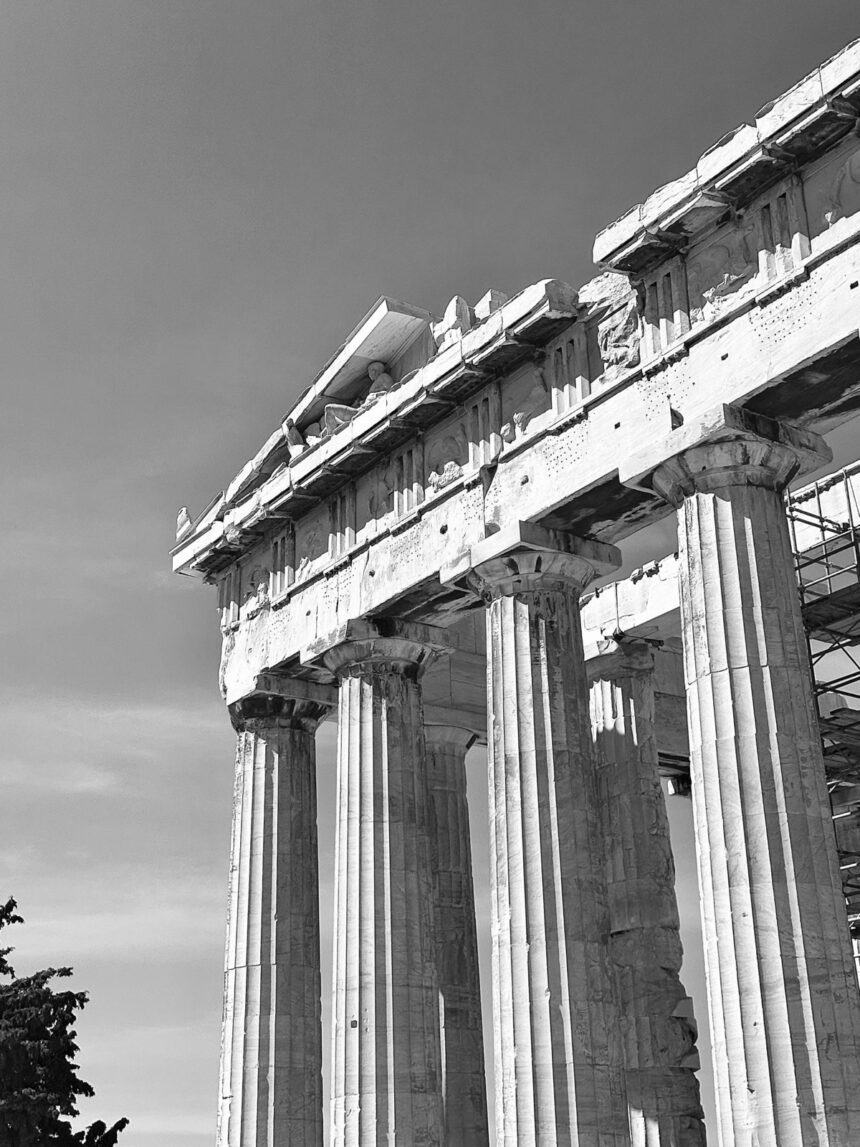
Most visitors reach the top of the Acropolis expecting a ruin frozen in time. What they actually find, more often than not, is a building site. There are cranes beside the Parthenon, scaffolding around a corner of a temple, neatly stacked blocks of fresh white marble next to weathered ancient ones. For some people this is a disappointment, a spoiler in the holiday photos. For others it becomes the most interesting part of the visit, once they understand what they are looking at.
The restoration of the monuments on the rock has been running, in one form or another, for well over a century. Early twentieth-century engineers did their best with the materials they had, joining fragments with iron clamps and bars. Iron rusts, expands and cracks marble, so much of the modern work since the 1970s has involved carefully taking that earlier restoration apart. Today the replacements are made of titanium, and every new piece of marble is cut to fit precisely against the ancient surface it will support. It is slow work, measured in years per section rather than weeks.
Seen this way, the scaffolding stops being an obstacle and starts to tell a story about how we care for old things. The small Temple of Athena Nike, perched on its bastion by the entrance, has been dismantled and rebuilt more than once. The Caryatids holding up the porch of the Erechtheion are faithful copies, while five of the originals stand indoors in the Acropolis Museum, safe from pollution, and a sixth is in London. These details are easy to miss if you simply follow the crowd from the gate to the viewpoint and back again.
This is where an acropolis guided tour can make a real difference. A good guide will point out which blocks are ancient and which are new, explain why the Parthenon’s columns lean ever so slightly inwards, and show you the traces of later lives the building has had as a church, a mosque and, briefly, a gunpowder store. The monument stops being a postcard and becomes a document, something you can read layer by layer.
A few practical points help. Arrive at opening time or in the late afternoon, when the light is kinder and the queues are shorter. The marble paths are polished smooth by millions of feet and can be surprisingly slippery, so leave thin-soled sandals at the hotel. Entry now works on timed slots, which makes booking ahead sensible rather than optional, especially in high season. And plan to visit the Acropolis Museum on the same day or the next, because the top floor is aligned with the Parthenon itself and holds the frieze sections that remain in Athens.
There is something oddly reassuring about seeing a monument of this age still being looked after by people with measuring tapes and hard hats. It suggests the Parthenon is not a relic that belongs only to the past. It is a building with a present, and quite possibly a long future, and the cranes are simply the most visible sign of it.